AI Halloween Pet Costumes: 12 Ideas and Exact Prompts
Twelve pet Halloween costume ideas for 2026, the exact prompt that keeps the breed and fur, and the photo rules that make the costume fit in one credit.
 Crazy Frog AI Video Team
Try it on this page
Photos are moderated and only used for this render.
Keep the identity and “avoid” lines. They are what stop the model from inventing a new face.
Sign in to upload and render. Your first pack starts at $9.90.
Pet costumes are the best first AI project. There is one subject, a clear silhouette and no identity politics. The costume is the only thing that changes, so the model has an easier job than it does with a group of people. The results are also the most shareable thing on this site.
This guide gives twelve ideas, the prompt that keeps the animal recognisable, and the photo rules that decide whether the costume looks fitted or floating.
The prompt that protects the pet
Every pet edit starts from the same preservation clause:
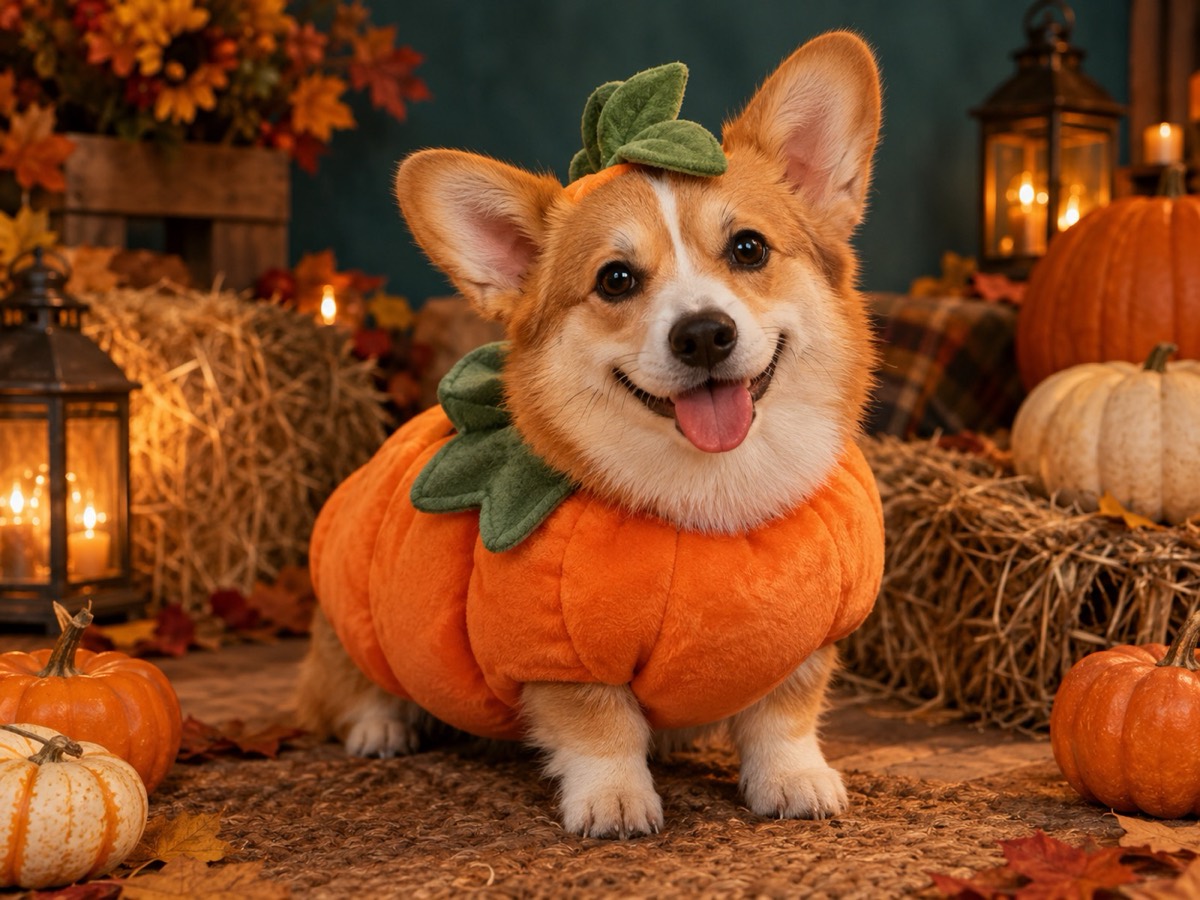
Use the uploaded pet photo as the primary reference. Preserve the animal's original breed, fur color, distinctive markings, eye color, facial appearance and natural anatomy. Dress the pet in a soft pumpkin-inspired Halloween costume with a small green leaf accessory. Keep the costume fitted naturally without covering the animal's eyes or changing its species. Place the pet in a cozy autumn photography studio with warm lighting and miniature pumpkins. Create a photorealistic professional pet portrait with realistic fur texture and natural shadows. Avoid extra animals, unnatural paws, duplicated limbs, text and watermarks.
Swap only the costume sentence for the ideas below. Keep the preserve and avoid clauses.
Twelve ideas that read in a photo
1. Pumpkin Pet. A soft pumpkin suit with a leaf. The safest first costume and the best for a card.
2. Glow-in-the-Dark Dinosaur. A green hood with rounded spikes and faint luminous seams. Works in a dark hallway.
3. Baked Potato. Foil, butter and a little parsley. Ridiculous in exactly the right way.
4. Stick of Butter. A yellow block with a silver wrapper. Reads at thumbnail size.
5. Headless Horseman. A tiny cape and saddle, with the pet’s head still visible. The joke is the missing rider.
6. Cousin Itt. A wig of long hair with two eyes peeking out. Only works if the pet tolerates a wig.
7. Bat Cat. A black cape and tiny wings. High contrast on a light floor.
8. Witch’s Familiar. A pointed hat and a small cauldron. The hat must be secured, or the model will float it.
9. Ghost Dog. A white sheet with eye holes. The simplest possible costume and the funniest in motion.
10. Spider Pet. A black suit with four soft extra legs on each side. Keep the real legs visible.
11. Corn on the Cob. A yellow body and green husk collar. Bright, silly and cheap.
12. Tiny Tax Collector. A suit, a tie and a clipboard. The prop does the joke.
The two rules that make a costume fit
Do not cover the eyes. A pet with hidden eyes stops reading as that pet. If the costume includes a hood, ask for it to sit behind the ears.
Keep the costume fitted. A floating shell or an oversized collar is the most common failure. Add “fitted naturally, follows the body shape, realistic fabric tension” to the costume sentence.
Taking the photo
Get down to the animal’s eye level. Use daylight or a bright room. Avoid a dark coat against a dark sofa. If the pet is lying down, keep the pose; the model can dress a lying animal as easily as a standing one.
A treat held just above the camera is the cheapest way to get a forward-facing shot. You do not need a studio; you need the eyes and the silhouette. Crop out people before uploading.
Do not use a photo of someone else’s pet without permission. Do not put a costume on an animal in real life if it restricts movement or breathing; the AI version is the safe version.
From portrait to a short clip
Once the portrait works, animate it with a small motion: a blink, an ear flick, a head turn, a paper bat drifting past. Three to five seconds is enough for a story or a Reel.
Keep the camera locked or use a very slow push-in. Running pets and fast camera moves are where pet videos fall apart anatomically. If you want a chase, generate several short clips and cut the best half-second from each.
What it costs
One credit per still. The $9.90 one-time pack has 15 credits, so 15 portraits. A 12-second 480p video costs 15 credits. Failed renders are refunded automatically.
If you are testing a costume, generate two and compare. Two credits is cheaper than a costume the animal wears once and then hides from.
Why this is a good business asset too
If you run a pet business — grooming, boarding, walking, a pet shop — a set of AI costume portraits is a seasonal content calendar that costs almost nothing. Twelve portraits is twelve posts. The same images can become a story highlight, a printed card, a menu cover or a paid add-on.
The important part is consent and honesty. Say the image is AI-generated. Do not present it as a photograph of a customer’s pet unless the customer asked for it and approved the result. The novelty is the point; the deception is not. A small “AI-generated preview” label in the corner costs nothing and keeps the post on the right side of the platform rules.
Printing the portrait
A phone screen hides small errors that a print makes obvious. Before you order a card or a canvas, open the render at full size and check the paws, the collar and the edge of the costume. If the print is larger than A4, generate at the highest resolution the tool offers and keep the animal at least a third of the frame; a small pet surrounded by props loses fur detail when enlarged.
A short checklist
- Eye level, good light, whole animal visible.
- Crop out people.
- Keep the preserve clause.
- Swap only the costume sentence.
- Keep the eyes uncovered.
- Ask for a fitted costume.
- Animate with one small motion.
Ready to try one? Open the pet costume generator, upload the photo and pick Pumpkin Pet. If you want the human version, the costume generator uses the same structure. And if you want a moving clip, the Halloween video generator can animate the still.